Friday, October 06, 2017

Cleo Brown - To Be Loved: A Film Review of ‘Loving’


For my birthday this year, a good friend took me to see the movie Loving. Written and directed by Jeff Nichols; the focal point of the film is an interracial couple named Loving who illegally married one another, in effect, violating  Virginia’s miscegenation laws. The film stars a beautiful and demure Ruth Negga and a stoic yet handsome Joel Edgerton as Mildred and Richard Loving.

At first glance, the film appears tedious and boring moving at a snail’s pace. Before I knew it, however, I was caught up in the struggles of this extraordinary couple, and their three children who were banished from Virginia for a period of twenty-five years. Eventually, the case of Loving vs. Virginia became a landmark 1967 United States Supreme Court civil rights case invalidating all miscegenation laws in the United States.

Unfortunately, the film ends much too soon, with the high court’s ruling.  The film, having gotten so caught up in the struggle of the Lovings, we the viewers are left pondering about the outcome of this family in the aftermath of the decision.

Nevertheless, film couldn’t have come at the right time, a time when when blacks and whites in the United States are polarized along racial lines. Perhaps in some small but significant way, Loving, the story of a white man and black woman who only sought to love each other and raise their children in peace and harmony serves as a powerful example to all of us throughout this holiday season to get along, to love and to be loved. For to love and to be loved is all that the Lovings and their children sought.


On a scale of from one thru ten I rate LOVING a 9+.

Cleo Brown is the movie reviewer for HipHopRepublican.com. She lives in Manhattan and has a Master’s Degree in Contemporary African-American History from The University of California at Davis and has done work on a Ph.D. in education at The University of San Francisco. She has published several poetry books and is featured in Who’s Who in Poetry

Wednesday, September 14, 2016

How the GOP will change after Trump


How much will the Republican Party change after the Trumpocalypse? Zero. Nada. None at all.

Leaders at every level have signaled that white nationalism is now acceptable in the Party of Lincoln. From Paul Ryan to Scott Walker to Marco Rubio, senior figures have confirmed that tax cuts are a higher priority on the Republican agenda than basic human rights and civil liberties.

No one can unring that bell.

Many Republicans fantasize that after Trump’s defeat the party will execute a miraculous “pivot,” restoring sanity and regaining some semblance of relevance. Unfortunately, our embrace of racist groups will dictate the party’s short, grim future. A change of direction is impossible because all of the party’s feedback mechanisms have been systematically dismantled.

The Politics of Crazy has eroded the social capital institutions that once blunted the influence of dumb ideas and daffy candidates. A conservative entertainment complex has destroyed any means by which Republican voters might confront dissonant information. Whatever organizational structure the party once enjoyed has been replaced by a vampire squid of grift, a matrix of interconnected cons funneling contributions down a bottomless hole.

Very few of the people who built this mess have any stake in the outcome. If RNC Chairman Reince Priebus fails to retain his position next year, he’ll leave the worst job on the planet to quadruple his income (at least) with a fat position on K street. For Laura Ingraham, Rush Limbaugh, Ann Coulter and the rest of the conservative entertainment complex, the show will go on without pausing to apologize. The same people who bought tickets to see Dinesh D’Souza’s 2016: Obama’s America will fork over more cash for next year’s low-budget sequel. Nobody pays for getting it wrong.

With the party stripped of feedback mechanisms, Trump’s defeat will do nothing to interrupt the GOP’s decline. The kind of people who think climate change is a hoax aren’t going to reconsider their life choices just because some guy lost an election.The Reagan coalition is dead, but the remaining members can’t smell the corpse. They don’t understand why their rhetoric falls flat. They have no idea why younger voters have rejected them. They can’t comprehend why their policies are failing in the places that have adopted them. Most of all, they refuse to rethink the positions and rhetoric that have driven non-white voters from the party.

After November, Republican leadership will pretend that Trump was some kind of anomaly, an act of God like a hurricane or earthquake. There will be so-called “reforms.” Fresh slogans will be spray-painted over the same flaming dumpster. Smiling, cooperative, “well-spoken” black people will be paraded on stage at Republican events all over the country. No effort to soften the party’s tone will change the fact that 70% of Republican primary voters supported either Donald Trump or Ted Cruz in 2016. Those voters aren’t going to get smarter overnight. They aren’t going to reflect on their choices. And they aren’t going away.

Absent a fundamental reconstruction of the party it will never again nominate a competitive candidate for President. That reconstruction isn’t coming anytime soon, because there are no forces in the party capable of delivering it.

What does this mean for the party’s future?

The party’s shift toward a more open white nationalism is a terminal event that will play out across the next four years. Big losses in 2016 will probably be tempered somewhat by a fleeting recovery in 2018. Forces that boost Republicans in off-year races remain at work, though they continue to weaken. A few wins in 2018 will not be enough to staunch the bleeding.

By 2020 the demographic forces that have driven the party out of contention nationally will be impossible to ignore. That will be the first election in which a significant number of millennials have hit the real voting age – 35 – the age at which people start to participate reliably in politics. In the next Presidential election millennials will be nearly 40% of eligible voters. Beyond 2020 they will completely dominate our politics.

Wednesday, July 08, 2015

Joseph Hunter: The Case for Jeb Bush

After months of Hamlet-like vacillation, John Ellis (Jeb) Bush decides to join the 2016 Presidential race. The leader among all of the declared and undeclared Republican presidential candidates, Bush offers something most of the candidates do not–executive experience running a state that the GOP must win in order to win the 2016 election. Still though, many Republicans remain skeptical of Mr. Bush, some flatly refusing to vote for “another Bush.” Here are 3 reasons why Republicans should keep an open mind about the Jeb Bush candidacy.

Reason One: Jeb Bush Joins the Race Enjoying Advantages the Other Candidates Envy

Martin O’Malley, Carly Fiorina, and Ben Carson share a common first hurdle to a successful White House bid–earning widespread name recognition. For some candidates, their relative obscurity serves them well: Senator Marco Rubio, for example, can define himself on his own terms. Martin O’Malley, on the other hand, struggles to get any attention at all. For Jeb Bush, name recognition cuts both ways: on the one hand, Bush enjoys the benefits of belonging to a respected political family that Americans feel as if they know. After all, the only Republicans to win the White House since Ronald Reagan were Bushes. Still, though,Jeb must make the case that he is his own man, worthy of the job on his own merits, not just because of his last name. That task represents an opportunity similar to Senator Rubio’s.  Being from such a successful political family brings with it two more important advantages–networking and money. Leading up to his announcement, Bush has been cobbling together an enviable campaign team of big names like Danny Diaz, Heather Larrison, and Alex Lundry. Many of these people worked on Mitt Romney’s 2012 campaign and worked for George W. Bush as well. Heather Larrison leads Bush’s dynamic fundraising team that has been greatly outpacing his rivals’. Mr. Rubio, also from Florida, has been struggling to build his fundraising base upon Florida donors, because Bush’s influence in the state is deeper and wider-reaching. In fact, whichever candidate performs worse in Florida’s winner take all primary will likely end his White House bid immediately thereafter.  Name recognition, deep political networks and strong fundraising abilities are important aspects to running a winning campaign. 

Reason Two: America Values Individual Accomplishment More than Bloodlines

By far, the most braindead “argument” against a Jeb Bush presidential run (and in fairness, against Hillary Clinton as well) is “Not Another Bush.” This reticence to support Mr. Bush purely based on his last name indicates immaturity and irrational thinking. For those of us who have siblings, would it be fair to say that knowing one of you is the same as knowing the other? Do you think the same as your siblings on all matters? Do you think the same as your father on all matters? Most matters? Most bothersome about the “Not Another Bush” line, is that it runs contrary to America’s greatest ideal, that which sets us apart from our European kin: America values the individual more than the bloodline. And we should continue to do so. Betraying that idea betrays the notion that anyone can “make it” in America if he or she just works hard and plays by the rules. By this standard, Jeb Bush has earned his right to be taken seriously along with the other candidates because he governed Florida successfully and conservatively. At present, he appears to be an upstanding man with a good family (all families face challenges, of course). He holds his own policy positions that may vary from his brother and father, and still fall within the conservative spectrum. On these elements should he be judged, not on his family lineage.  

Reason Three: Jeb Bush Falls within the GOP Mainstream

The 2016 GOP candidate will surely need the support from the broadest coalitions of the conservative movement. He or she will need to speak most of all to social conservatives, economic conservatives, and defense-minded conservatives. On the issues most important to these constituencies, Jeb Bush falls within the mainstream. Unlike George Pataki, Bush holds a consistent record opposing abortion. Unlike Mike Huckabee, Bush does not need to defend himself against allegations of reliance on federal funds during his governorship. Unlike Rand Paul, Bush speaks clearly about reinstating a forward-leaning foreign policy.  Furthermore, for Bush’s conservative bona fides, he strikes a moderate tone–an important ingredient for any GOP candidate to win the general election. Without a doubt, Mr. Bush faces a list of challenges and formidable candidates in his 2016 bid. While he leads the pack in most polls, his lead wanes–most notably, in Florida. Still, though, Bush represents a serious candidate in whom Republicans can take pride. A welcome addition to the large field of candidates, Jeb Bush deserves serious consideration in his own right.

#####

About the Author: Joseph Hunter is a conservative writer from Chicago who blogs at Black and Red. You can follow him on twitter @blkandred.

Cleo Brown: The Conservative Case for “Housing First”


According to the U.S. Department of Housing and Urban Development (HUD), homelessness is defined as “people who are living in a place not meant for human habitation, in emergency shelter, in transitional housing, or are existing in an institution where they temporarily reside for up to ninety days; or people who have lost their primary night-time residence, which may include a motel or a hotel.”

Similarly, the online encyclopedia Wikipedia, defines homelessness as “the condition of people without a regular dwelling-people who are homeless are most often unable to acquire and maintain regular, safe, secure and adequate housing, or lack “fixed, regular and adequate night-time residence. The term ‘homeless’ may also include people whose primary night-time residence is in a homeless shelter, a warming center, a domestic violence shelter, a vehicle, cardboard boxes, a tent,” etc. The United Nations defines homelessness as “rooflessness.” This includes people “living in the streets without shelter”; and “persons with no place of usual residence…including dwellings, shelters, and institutions for the homeless or other living quarters.”

As of 2005, there were at least 100 million homeless people world-wide. There are currently, according to the National Law Center on Homelessness and Poverty, between 2.3 and 3.5 million people experiencing homelessness in the U.S.A. And, according to a 2008 study by HUD, in January of 2007, 671, 888 people experienced homelessness. The study concluded that about 58 percent lived in shelters and transitional housing while the other 42 percent were unsheltered. In 2010, another group, AHAR (Annual Homeless Assessment Report) found that 1,593,150 individuals were homelessness, of which 85 percent were single and 75-80 percent were male.

Friday, April 10, 2015

Why Rand Paul’s presidential bid should matter to black America


It is official.
Senator Rand Paul (R-KY) is running for the Republican nomination for president in 2016.  But why should black America care?
Pay close attention to his views on mass incarceration and the war on drugs, which could move the Republican Party forward on criminal justice reform and possibly attract blacks, younger voters and other Democratic base voters. But don’t lose sight of the senator’s past statements against civil rights, which sound a lot like the same ol’ GOP story.  And that story, brought to you by the tea party, has not been very friendly to black people these days.
“I am running for president to return our country to the principles of liberty and limited government,” Paul said on his campaign website.
Source: The Grio. Read full article.

A Republican Governor Is Leading the Country’s Most Successful Prison Reform

Photo: Davis Turner / Getty Image

During his second inaugural address this past January, Georgia Governor Nathan Deal shared the story of Sean Walker. After serving 12 years of a life sentence for murder, Walker was paroled in 2005 and began working in the governor’s mansion while in a state transitional center. At the time of Deal’s address, Walker was working for Goodwill as a banquet catering sales coordinator and was nominated for Goodwill International Employee of the Year. As of January, Walker was planning to take college courses with the hope of becoming a counselor.
Deal, who got to know Walker at the governor’s mansion, shared the story to underscore his own “message to those in our prison system and to their families: If you pay your dues to society, if you take advantage of the opportunities to better yourself, if you discipline yourself so that you can regain your freedom and live by the rules of society, you will be given the chance to reclaim your life.” He continued, “I intend for Georgia to continue leading the nation with meaningful justice reform.”
Source: The New Republic Read full article.

Republicans for Same Sex Marriage


This is what the GOP might look like when the culture wars finally end.
Republicans in Massachusetts have openly backed same sex marriage, joining an amicus brief filed by former RNC Chair and Bush Administration official Ken Mehlman.
Almost all of the party’s major figures in Massachusetts have signed the brief including new Governor Charlie Baker. Also signing the brief are Maine Senator Susan Collins and Republican donor David Koch.
The brief makes the conservative case for same sex marriage rights, citing a laundry list of favorite conservative cases and authors. This quote from Barry Goldwater’s Conscience of a Conservative is particularly biting:
“The Conservative is the first to understand that the practice of freedom requires the establishment of order: it is impossible for one man to be free if another is able to deny him the exercise of his freedom. … He knows that the utmost vigilance and care are required to keep political power within its proper bounds.”
A few other excepts:
The governmental bans at is-issue here rest on similarly ungrounded, archaic, and obsolete beliefs—however sincerely, strongly, or long held—and thus the Fourteenth Amendment requires recognition of the bans’ invalidity.
This Court has repeatedly made clear that although legislators and voters may generally exercise power over certain subjects—including many contentious social issues—the government’s power is limited when it comes to injurious incursions upon the freedom of minorities.
No one at any point in this decades-long debate has been able to describe any credible harm that might rise from same sex marriage. Cut through all the bullshit, and the argument against same sex marriage is absolutely singular – “my religious convictions dictate that homosexuality is wrong.” That’s it.
People are asking the government to discriminate against homosexual couples on the basis of sectarian religious beliefs. There is absolutely no defense for that practice under our Constitution.
When same sex marriage is finally settled law in this country, religious people will remain free to hold their beliefs about the sinfulness of gay couples. They will lose their ability to use those beliefs to constrain the basic Civil Rights of other people.  We all have a right to our religious beliefs. No one has a right to legislate their religious beliefs.
This isn’t a dispute about religious freedom. This is a dispute about cultural supremacy. That’s why the last, most bitter holdouts against gay marriage are the same institutions, people and states who were the last bitter holdouts against the Civil Rights movement.

Gay marriage is likely to destroy something, but it’s not marriage. The fight over gay marriage is going to severely damage the lingering cultural supremacy once enjoyed by white Protestants.

We are on the cusp of experiencing real pluralism for the first time in the country. That’s why same sex marriage matters and that’s why the battle lines are drawn across the same boundaries as in the Civil Rights movement.
Massachusetts Republicans are recognizing, a little late, what most of the rest of the country has already come to terms with. If the party at large has the good sense to drop this issue then a lot of future harm can be avoided.
The full text of the conservative amicus brief in favor of same sex marriage can be found here.
#####
About the Author: Chris Ladd is a Texan who is now living in the Chicago area. He is the founder of Building a Better GOP and has served for several years as a Republican Precinct Committeeman in DuPage County, IL, and was active in state and local Republican campaigns in Texas for many years.

HHR Interview with Leah Wright Rigueur, author of The Loneliness of the Black Republican


Like most Ivy League professors, Leah Wright Rigueur is not a Republican. Yet like most African-Americans, shefound it curious that anyone would be. “African-Americans should not be Republicans, nor should they be conservatives Rigueur opens her new book,The Loneliness of the Black Republican. And yet they are.
Rigueur wanted to know why.
Consequently, she gives us a 310-page history which introduces us to figures from the obscure (Arthur Fletcher) to the notorious (Barry Goldwater); and facts unknown about the famous – both revered (Jackie Robinson) and reviled (Richard Nixon).
On first blush, Rigueur may not endear herself to her book’s subjects by calling them “lonely.” But the Harvard historian points to Clarence Thomas as having first characterized black Republicans as “lonely”; and the conservative scribe Shelby Steele who did the same.
More importantly, in her new book, Rigueur wants us to know that black Republicans haven’t just been “lonely,” they’ve been integral to the American civil rights struggle. The Kennedy School historian delved through what she estimated, in an interview with HHR, to be some 20,000 documents shedding light on some 44-years of American history. And she tells 44-years of American history through the lens of a group she maintains has had underappreciated influence.
“At times,” Rigueur writes:
…we find not a peculiar group of blacks, desperate for white acceptance or out of touch with American realities but rather a movement of African-Americans working for an alternative economic and civil rights movement.
That passage defines the books approach. Subtitled “Pragmatic Politics and the Pursuit of Power, the book locates conservative Africans-Americans making pragmatic trade-offs, working on the American Right whilst simultaneously working to advance black interests.
At turns, both critical and laudatory, Rigueur’s narrative coins seemingly-oxymoronic concepts like “progressive conservatism,” reacquaints us with ideas which have fallen into disuse with the passage of time like “Black Capitalism,” and delivers what (to some) maybe be implausible news that the Father of Affirmative Action was a Republican.
Yet we also learn that “#NegroSpotting” at Republican conventions isn’t something that was invented byBaratunde Thurston in 2012, but black satirists have been doing that since at least the 1972 convention.
Black Capitalism was – and is – an attempt “to use economics as a way to move past traditional protest politics, Rigueur explains. “Black capitalism is black power in the best sense of the word,” read a glossy advertisement Richard Nixon’s campaign took out in the 1968 issue of Jet magazine. And she chroniclesthe impressive investments made by administrations like Nixon and Fords in historically black colleges & universities, school desegregation, black businesses grants, and contracting with minority businesses at Nixon’s Inauguration and GOP functions – to the tune of billions of dollars.
Yet, when Rigueur trains her critical lens on the GOP outreach project, she explains, that the GOP hasperennially suffered from a cynical strain in the party which believed as Goldwater groaned in 1964, “We’re not going to get the Negro vote as a bloc,” so why bother trying to get any of it – culminating in Pat Moynihan’s infamous “benign neglect” memo.
Rigueur’s greatest achievement in this book might be offering this insightful tool to analyze the GOP:great GOP policy has often been undercut by horrendous GOP politics. Nixon was a pioneer in desegregating schools, but severely hobbled its success by undermining the political will needed to achieve it. Likewise, combating negative black stereotypes visa-vi Black Capitalism was undermined by the political strategy that spoke in terms of “law and order” and “welfare queens. All of which, left many in Nixon’s black Cabinet “collectively searching their souls to justify their own participation” in the party.

HHR interviewed Professor Rigueur about her book. What follows are highlights of that interview.

HHR: You introduce us to lots of obscureyet historically-important, figures in this book whom many have probably never heard of before – black Republican White advisors to Presidents Eisenhower, Nixon, Ford, and the RNC – names like: E. Fred Morrow, Bob Brown, Stan Scott, Helen Thomas, and Transportation Secretary Bill Coleman. A notable one is Arthur Fletcher. In a 2005 NPR interview, hisgranddaughter, Phyllis Fletcher, explained her father had T-shirts made which read: “Father of Affirmative Action” he handed out at speaking engagement,” and she said:
“Art Fletcher did something good for black people—something that belongs in the history books…I knew he was frustrated people didn’t know his name like Martin Luther King or Malcolm X…The T-shirts—I’m sure they’re headed for Goodwill. But with any luck someone will see one and get curious, they’ll find a computer and they’ll look up ‘The Father of Affirmative Action,’ and they’ll find the stories that made his life so frustrating [yet] so meaningful.”
Art Fletcher and Rosa Park died in the same year, why does everyone know about one but not the other?

Monday, March 16, 2015

Many Conservatives are Blowing it on the Ferguson DOJ Report

Their reaction is neither fair, accurate, nor good for America.


It’s unfortunate, the way news is consumed and interpreted in the age of twitter. Everyone feels tremendous pressure to form an opinion quickly and state it loudly and with certainty. Once this has been done, people are highly resistant to changing their minds and they become impervious to new evidence, often dismissing out of hand outright facts just because they are reported by a given source (e.g., “the media is untrustworthy” or “you can’t trust the Holder Department of Justice.”) Perhaps nowhere has this phenomenon been more obvious (or regrettable) than in Ferguson, Missouri, in the wake of the shooting death of Michael Brown. 

Interpreting the news out of Ferguson has become a part of ideological tribalism in which, if you are a conservative you stand for the Ferguson PD and if you are a liberal you stand against them. Thus, liberals have become highly resistant to assimilating information that strongly suggests that “hands up, don’t shoot” never happened. Conservatives, on the other hand, have become highly resistant to assimilating information that strongly suggests that the Ferguson PD – as with many other municipal police departments in the country – truly is out of control, in that it recklessly violates the constitutional rights of the citizens of Ferguson and does so in a manner that has a clearly disproportionate impact on minorities.
Source: Red State. Read full article.

Why Conservatives Must Engage Urbanism

Is there a place for conservative urbanism?
That was the question prompted by Charles Marohn’s recent New Urbs article, “The Conservative Case Against the Suburbs.” Ben Adler, an environmental reporter over at Grist, said the conservative base will never listen to the lonely (though growing!) conservative urbanist voices. Keith Miller at Mere Orthodoxy argued conservative urbanists are abusing Ronald Reagan’s political legacy in favor of elitist technocratism. Both pieces help illustrate just how limited urbanist politics have been, and just how important the New Urbs project (along with our like-minded friends across the conservative landscape) could be for broadening this discussion.
Adler documents how “urbanism is actually growing in popularity among a small cadre of conservative intellectuals,” who “understand that the traditional town design favored by urbanists—houses that face the street, with porches and stoops, sidewalks, public parks, and shared mass transit—fosters strong communities.” Yet he warns: “Just don’t expect their ideas to catch on in conservative America.” He continues, “The main problem for conservative urbanists isn’t the quality of their arguments, but rather that they fall on deaf ears within their own movement.” Adler argues that popular American conservatism is about tribalism before principles, and subsidized suburbia suits them just as Tea Party retirees are fiercely defensive of their own entitlement checks. American conservatives are coal-rollersand Sarah-Palin-Big-Gulp celebrators, who “have adopted pro-market, small-government values as a loftier framework for their politics of resentment.”
Source: The American Conservative. Read full article.

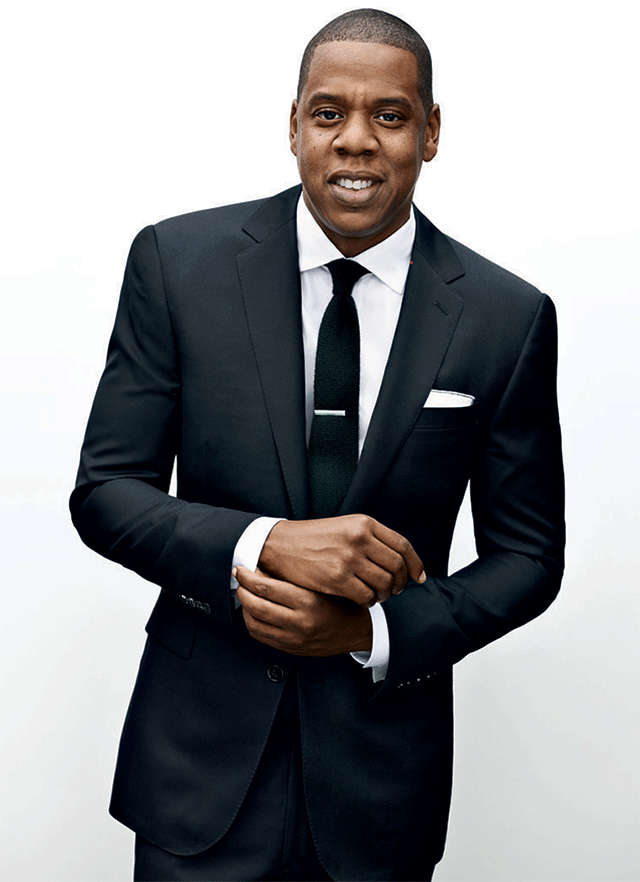
Jay-Z’s Ideas on Policing and Criminal Justice Reform Matter


In light of the recent police brutality cases occurring across the nation, Democratic Governor of New York Andrew Cuomo met with the mogul and nineteen-time Grammy Award-winning rapper Shawn “Jay-Z” Carter to discuss criminal justice policy. With the clear intention of being insulting, the writers of an article, which was posted at both the New York Post and Fox Nation, referred to Carter as a “former crack dealer.” The text of the article further posits that Carter “earned most of his expertise in crime as a crack dealer.” Those who are critical of people like Jay-Z contributing to criminal justice policy demonstrate their lack of dedication to serious criminal justice reform.

First, it is important to note that there is something deeply repulsive about dismissing all of Jay-Z’s glittering achievements and referring to him by a name that reflects the worst part of his history. Not everybody has sold crack, but everybody has aspects of their pasts upon which others can look down. It takes a peculiar level of wickedness, however, to see a man who has risen to the status of having a combined, legal net worth of $1 billion with his wife, the seventeen-time Grammy Award-winning vocalist and musician Beyoncé, and use his past to devalue his undeniable contribution to society as an upstanding citizen. 

It is interesting that those who pay continued lip service to the idea of the disadvantaged lifting themselves up by their own bootstraps and turning their lives around are the same people who are the first lobbing cruel rhetorical grenades at those who have worked hard, defied the odds, and reached the zenith of their professions.

Source: Change the Game: Read full article.

William Reed: Celebrating and Critiquing “The Great Society”


Having the nation's first African-American president at the Civil Rights Summit speaks to the immeasurable success of Lyndon Baines Johnson’s presidency. The Civil Rights legislation LBJ pushed through Congress is the most transformational political legislation since Reconstruction. Legislation Johnson offered and leadership he proffered has contributed to the betterment of African Americans’ lives in ways no president has since Abraham Lincoln. Contemporary Black Americans would be advised to take note of how a president stepped into the breach and helped our race in the realization of America’s promise.

When Black Americans measure Obama with LBJ, they will see “a man with a plan” versus an empty suit. Many Blacks can’t see beyond the symbolism of the Obama presidency. While Obama shies away from Blacks and their issues, LBJ had a vision for America, that problems of housing, income, employment, and health were ultimately a federal responsibility; and from that premise Johnson used the weight of the presidency and his formidable political skills to enact the most impressive array of reform legislation since the days of Franklin Roosevelt. He envisioned a society without poverty or discrimination, in which all Americans enjoyed equal educational and job opportunities. He called his vision the "Great Society."

What If You Live in a Bad City?


This is something I’ve thought about a lot. And it applies to living in a “bad” town or rural area, as well. What if you live in a place that is ugly, broken-down, dangerous, bereft of community? Is it better to leave? And if you stay—how do you help transform such a place?
There are different kinds of “bad” cities, and thus different ways of trying to involve oneself in the betterment of those cities. If any commenters have thoughts on “bad” cities or towns they’ve lived in, and how they’ve worked to get involved in those places, I would love for you to share your thoughts.
One of the first sorts of “bad” cities that comes to mind would be the dangerous one—a city that has enough crime and hostility within it to make inhabitants feel uncomfortable and alone, a city in which it’s difficult to trust people. There are rural areas like this, too—indeed, cities aren’t any more dangerous than rural areas,according to the numbers. How to build community here is a difficult question, one that I don’t have a holistic answer to (and it’s probably a question that doesn’t have a perfect answer). But one potential answer comes from Why Place Matters, an excellent book recently published by The New Atlantis. William A. Schambra, director of the Hudson Institute’s Bradley Center for Philanthropy and Civic Renewal, wrote an essay for the volume about “Place and Poverty,” in which he tells the story of Family House, a ministry in inner-city Milwaukee.

Chidike Okeem: Dr. Carter G. Woodson and Black History Month


Eminent black historian Dr. Carter G. Woodson started Negro History Week in 1926, which intended to redress the lack of attention paid to black achievement in society and in academia. This later morphed into Black History Month. However, Black History Month, as it exists today, is a lukewarm version of what Woodson envisaged. Woodson wanted Negro History Week to be a celebration of black achievement, history, and culture. However, looking at the tepid practice of Black History Month today, one would be excused for erroneously believing that the bulk of black historical achievements began in the 1950s.
Dr. Carter G. Woodson, the second African American to receive a Ph.D. from Harvard University after renowned sociologist W. E. B. Du Bois, was famously both pro-African and pro-capitalism. Woodson understood the freeing power of capitalism and the potential it has for self-uplift. For serious, solution-oriented black conservatives today, Woodson provided a model of how one can be enthusiastically pro-market, doggedly anti-Marxist economics, and do so while being unapologetically African. He demonstrated that endorsement of free market economics does not have to coincide with self-hatred and anti-blackness.
Ideally, Black History Month is something that should be unnecessary in the Western world in the 21st century. Those who make the argument that black history should not be relegated to a limited period of time on the calendar make a point that is worthy of noting. However, Woodson’s goal in creating Negro History Week was to encourage the widespread appreciation of black historical achievements, and it was a necessary tool when he created it. The fact that Black History Month still continues today demonstrates the sheer extent of the erasure of blackness from the great achievements of history. It demonstrates that blackness is still undervalued, unappreciated, and only recognized when it can be attached to abjection and negativity. By now, the Western world ought to be at a point where black achievements are afforded as much respect as the achievements of other groups.
If Black History Month is to stay true to Woodson’s vision, then promotion of black achievement needs to be the focus. Rather, as it exists today, Black History Month predominantly focuses on Brown vs. Board of Education in 1954, the Montgomery Bus Boycott of 1955-1956, the Civil Rights Act of 1964, the Voting Rights Act of 1965, and other breakthroughs from oppression that occurred during that period. It is crucial to note that Woodson died in 1950—before the monumental events and milestones of the modern civil rights movement began. Given that Woodson was not alive for the bulk of the civil rights gains of the 1950s and 1960s, the modern civil rights movement could not have been part of his vision for the recognition of black achievement. Woodson astutely believed that asserting the importance of black people to world civilization was an inextricable component of reducing the prevalence of anti-blackness and racism in the Western world. Spotlighting freedom from oppression was not the primary goal of Negro History Week, inasmuch as Woodson knew there was more to black achievement and black culture. Woodson understood that the history of black Americans does not begin with slavery; rather, it begins with grand, ancient civilizations in Africa.

The Republican Who Ended Homelessness

Philip Mangano may have created  the model for ending homelessness in America.

Say what you will about George W’s tenure as POTUS, but apparently his homelessness czar Philip Mangano knew what he was doing. Mangano was a major proponent of a “housing first” approach to homelessness, which actually seems to be working. “Between 2005 and 2012, the rate of homelessness in America declined 17 percent.” Furthermore, studies now show that it actually costs three times as much money to leave the homeless on the streets and pay for subsequent problems, than find them housing.

HHR Music Videos of the Month: V. Nova – How It Is ft. David Godfrey

A Republican Against Prisons


Mark Earley is not the only conservative who now sees mass incarceration as a social evil rather than a policy solution. But like other mass traumas, the prison explosion has generated thick clouds of mythological fakelore. For instance, many conservatives ardently believe that mass incarceration is somehow a byproduct of the welfare state’s postwar growth. But like it or not, nations with more lavish welfare states, as in Northern Europe, have radically lower incarceration rates than those of the United States. On the left, it’s widely believed that ending the war on drugs would speedily end mass incarceration. But the fact is, even if every single nonviolent drug offender were released tomorrow, the U.S. would still have the highest imprisonment rate in the world, barring a few tiny outlier island nations.
Source: The American Conservative Read full article.

Sean Jacobs - From the Solomon Islands to Houston: the harmful trend of government dependence

At a recent dinner in Honiara, capital of the Solomon Islands, a friend commented on the unprecedented and increasing level of government dependence in the idyllic South Pacific nation of half a million. National elections, taking place at the time, were about how much the Solomon Islands could do for you rather than what you could do for the Solomon Islands (to muddle John F. Kennedy’s famous words).
This trend is not just confined to ‘the Happy Islands’ – it’s clearly a discussion taking place among rich and poor at dinner tables around over the world. Annual budgets in neighboring Australia, for example, stir pockets of outrage that the ‘government should do more’ or ‘is not doing enough’ in areas it wishes to ease spending taxpayer money.
Political leaders now spend considerable time preparing citizens for a ‘killer budget’ – as if preparing for major surgery or going to war. In the United States the government routinely plays the role of ‘Santa Claus’, in the words of one commentator, by showering ‘the public with something for nothing in every department – free health care, free retirement security, free protection from hazardous consumer products and workplace accidents.’
Certainly, from crumbling roads to lousy policing, state performance leaves much to be desired in the developing world. But, regardless of where we are, excessive government dependence is a growing and ultimately harmful trend.
Government expectations as we now understand them weren't always at their current default levels. ‘The Greatest Generation’, for example, enduring a depression and two world wars, would've felt embarrassed in having the government pay their medical bills or living a responsibility-free life on the state. Historically, in the South Pacific, government dependence eased with exposure to the outside world, and where commercial and community activity thrived. Strangely, however, state expectations have emerged in an era of free markets where competition, privatization and less regulation have pushed government to the side.

Sunday, October 05, 2014

Book Review: The Wilder Shores of Marx: Journeys in a Vanishing World

The Wilder Shores of Marx visits five countries which still labor under systems inspired by the writings of Marx, Engels, Lenin and other luminaries of the left.
The most decisive thing that’s happened in my political lifetime,’ said John Howard in a 2009 interview, ‘is the collapse of Soviet imperialism. It dwarfs anything else.’ This is significant from Howard, whose political life covers nearly half a century.
His observation, however, is lost on a generation of younger Australians. Certainly, oppressive regimes exist today but are fewer in number, while command and control economics have been trounced by liberal market capitalism and globalization. For anyone under forty the idea of growing up on a planet of rivaling superpowers with conflicting ideologies is no doubt strange.
Tearing around New Zealand on a recent trip I found time to wade through Theodore Dalrymple’s The Wilder Shores of Marx. Dalrymple first published this back in 1991 after visiting the heights and ruins of communism in Albania, North Korea, Romania, Vietnam and Cuba. With usual wit and insight, he elucidates both the absurdity and grimness of life under the banner of Marxist-Leninism.
The absurdities are endless. An Albanian phrase book, for example, reminds him of a 1986 visit to Soviet-influenced Somalia where the travel pages brimmed with useful phrases such as ‘pass me the Opera glasses please.’ Somalia was, at this time, in the throes of a cholera epidemic. Kim Jong Il sank eleven holes-in-one on his first day of golf and his birth was, supposedly, foretold by a swallow. Fidel Castro once rose for a toast when dining with guests in Havana and, ten hours later, finally took his seat.
With these comical accounts one can almost lose sight of an ideological system estimated to have killed 94 million people (some feel this estimate is too low). And the less exquisite details about communism, especially in the Soviet Union, weren't well-understood or broadcast until after the Cold War.
There were, however, some that knew of the deception and tyranny. Here, for example, is a telling extract from the historian Robert Conquest’s Wikipedia: In fact many leading ‘thinkers’ journeyed from the West to the Soviet Union and left excited and impressed. ‘For decades,’ writes Dalrymple, ‘they blinded themselves to the obvious.’ We can add to this list the Australian historian Manning Clarke.
After the opening up of the Soviet archives in 1991, detailed information was released that Conquest argued supported his conclusions. When Conquest’s publisher asked him to expand and revise The Great Terror, Conquest is famously said to have suggested the new version of the book be titled I Told You So, You Fucking Fools.
Today the horrors of communism are so tragic they’re hard to fathom, especially for a younger generation who have known slim alternatives to freedom and prosperity. Che Guevara shirts are sported with ignorance by some while, for others, the modern imperfections of representative democracy are comparable to life in Pyongyang.

Patrick Derocher – Can the GOP Win Over Hipsters?

New York City Mayor Bill de Blasio and his home borough of Brooklyn are nothing if not shorthand for the policies espoused by the burgeoning populist wing of the Democratic Party. (Generally in a less than positive way.)

Separately, the same borough has become synonymous with hipster culture and its affinity for fixed-gear bicycles, obscure music, and putting birds on things. (The de Blasio – hipster connection has not gone unnoticed.) Intuitively, the link makes some sense; hipster enclaves like Chicago’s Wicker Park, Philadelphia’s Northern Liberties, and the entire city of Portland, Ore. represent some of the bluest and most culturally liberal parts of the country.

 But what if instead of treating hipsters with derision, Republicans embraced the trend? Although conservatives often chafe at the trappings of hipsterdom, including esoteric coffees, vintage and faux-vintage clothing, and $15 artisanal cocktails, the fact remains that every quirky brunch spot, every reclaimed furniture shop, and every combination coffee shop/craft beer bar is a business, many of them small, and all of them employing people. Moreover, these are all instances of individual entrepreneurs who saw a need in the market and in their community, and seized the opportunity to fill that need while employing others, growing the local economy, and, yes, turning a profit. These are values Republicans have espoused for years, and we should champion them wherever they provide benefit to communities. Regardless of the beards.

 Beyond individual businesses and their employees, the hipster ethic has the potential to transform entire neighborhoods and cities, and Brooklyn is perhaps the best example of this. Twenty years ago, the borough was a pariah, abandoned on the crime-ridden outskirts of New York City culture. Now, it represents the most sought-after brand in the city, and is the fastest-growing borough in terms of both population and economic strength. Though Brooklyn represents a somewhat extreme example of this shift, it exists on a much smaller scale: further upstate in New York, Ballston Spa has transformed from a case study in post-industrial economic stagnation to a thriving community of small, unique businesses and entrepreneurs who have poured their time, energy, and passions into rejuvenating their economy. (To be clear, this is no defense of the faux-entrepreneurs who spot an easy opportunity to co-opt hipness solely for their own gain). Moreover, there is reason to believe that Republican fiscal and regulatory policies can and will appeal to entrepreneurial 20- and 30-somethings.

For starters, more small business owners means more people with an incentive for lower taxes, and while this is not a uniformly Republican demographic, they are by and large more pragmatic in their politics and less likely to be straight-ticket voters. On a more micro level, GOP initiatives like the Uber petition serve to bring free-market solutions to immediately relatable problems that urban voters encounter on a daily basis. In the longer term, school choice has the potential to be strong selling point to a generation of individualist entrepreneurs getting ready to send their children off to school.

A hipster-inspired model of small-scale economic investments has the potential to be a template for economic growth in struggling cities across the country, and the Republican Party would be wise to encourage it.

#####

About the Author: Patrick Derocher is a native Upstate New Yorker and graduate of Fordham University.  In his spare time, he enjoys bike rides, the more obscure fiction of C.S. Lewis, and all manner of trivia.